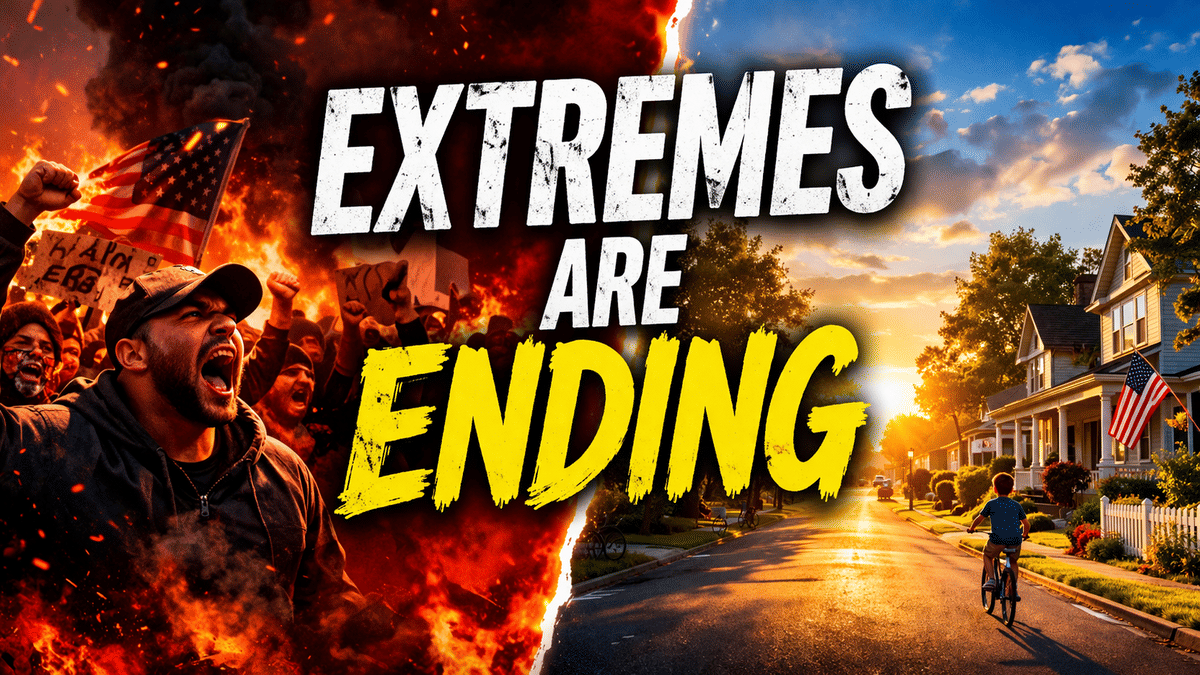
For nearly two decades, America has been living on adrenaline.
From the populist uprisings of the right to the moral crusades of the left, we’ve been trapped in a cycle of outrage, polarization, and identity wars that have left nearly everyone exhausted. But history suggests this fever will break — not through a miraculous consensus, but through the simple law of emotional gravity. What rises in chaos eventually falls into balance.
I’m right in the middle of reading a book that is changing my entire perspective on the past, present and future. It’s called The Fourth Turning, and this is just a snippet of the ideas presented in the book. I highly recommend you get a copy and read it for yourself.
If the book’s model of cyclical history holds true, the 2020s represent a crisis phase — the era of institutional decay, populist backlash, and cultural upheaval that sets the stage for a rebirth. And all the signs indicate that rebirth — a return to normalcy, moderation, and pragmatic problem-solving — is coming into view.
The Age of Extremes
The last decade or so has been one long argument.
On the right, the MAGA movement reshaped American conservatism around a figure rather than a philosophy. On the left, the progressive wave tried to redefine morality itself through social-justice absolutism. Both drew real passion — and both left enormous wreckage in their wake.
The political system, media ecosystem, and even personal relationships became saturated with moral totalism. Every election was “the most important in history.” Every disagreement was a test of loyalty. Every issue — from public health to pronouns — became a proxy for belonging to the right tribe. The result wasn’t enlightenment; it was burnout. Poll after poll shows a solid majority of Americans now self-identify as “politically homeless.” They want government to function, markets to deliver, communities to heal — and they want all of that without the shouting.
History’s Pendulum: From Crisis to Renewal
This longing for balance isn’t new. It’s cyclical.
Historians William Strauss and Neil Howe, in The Fourth Turning, describe American history as unfolding in roughly 80- to 100-year cycles called saecula. Each saeculum
Has four “turnings” that correspond to the stages of a human life. Each culminates in a crisis era, when old institutions collapse and new ones are built.
By their timeline, the United States entered its current crisis around 2008 — with the financial crash, global instability, and growing distrust in authority. If that’s correct, then the 2030s should usher in what comes next: a High — an era of reconstruction, civic unity, and renewed faith in competence.
We’ve seen this before:
1780s–1820s: The revolutionary chaos gives way to the Federalist consensus and constitutional order.
1870s–1890s: The trauma of the Civil War yields to industrial optimism and national expansion.
1945–1963: The Great Depression and World War II give way to the postwar boom and bipartisan normalcy.
Each crisis burns away a broken system. Each “High” rebuilds something sturdier — less ideological, more functional. The content changes; the pattern remains.
⚖️ The Post-Populist Horizon
So what might America’s next “High” look like? Probably not a retreat into old conservatism or a revival of radical progressivism. More likely, a fusion of classical liberal values and modern social tolerance.
We can already see the contours forming:
1. Cultural Cooling
Social debates will lose their apocalyptic edge.
Issues like same-sex marriage or gender expression, once culture-war flashpoints, are rapidly normalizing. Even among conservatives, there’s a growing sense of “live and let live.” The next cultural phase will be less about moral policing and more about social coexistence — a kind of “Live and Let Live 2.0.”
2. Pragmatic Politics
Voters will demand competence over charisma.
After years of chaos and performative outrage, politicians who can actually manage institutions — fix infrastructure, stabilize budgets, reform healthcare — will eclipse those who merely dominate headlines. The word “boring” may become a compliment again. In other words, a cry of “make politics boring again” by making sure the thing does its job.
3. Balanced Capitalism
The economy will tilt toward what could be called “innovation with a safety net.” AI, automation, and energy revolutions will create new wealth — but there will also be bipartisan appetite for making sure ordinary citizens share in that prosperity. Expect worker ownership models, simplified tax codes, and pragmatic environmentalism.
4. The Return of Civic Identity
Patriotism will come back, but as civic belonging, not nationalism.
After decades of fragmentation, Americans will rediscover pride in competence — in building, fixing, and governing well. The heroes of the 2030s won’t be demagogues or influencers; they’ll be builders, scientists, educators, and reformers.
Why Extremes Fade
Extreme movements rarely die in defeat; they die of overexposure.
The past decade’s ideological intensity has drained its own fuel. Once a movement begins to alienate its moderates, it fractures into purists and pragmatists — and the center slowly fills back in.
That’s what we’re seeing with MAGA’s internal splits and the progressive left’s generational fatigue. Both movements will leave behind cultural fingerprints, but neither will define the next era. Voters simply don’t have the stamina for permanent revolution.
The Coming “High”
If this pattern holds, the 2030s will mark the start of a new civic mood: calmer, more confident, less self-righteous. Institutions will rebuild legitimacy not through rhetoric, but through results. Public trust — the scarcest currency of the 2020s — will be painstakingly restored.
It won’t be utopia. No “High” ever is. The 1950s had McCarthyism; the Gilded Age had inequality. But the prevailing tone will be constructive rather than destructive — a culture of building instead of burning.
To borrow the language of Strauss and Howe, this is the moment when a new generation of “Heroes” — Millennials and Gen Z — steps forward to replace cynicism with purpose. The crisis that shaped them will have forged precisely the skills the next era demands: cooperation, resilience, and problem-solving.
Conclusion: The Calm After the Storm
Every American era begins with rebellion and ends with renewal. The 2020s may be noisy, bitter, and chaotic — but history says that’s the noise of old ideas collapsing, not the sound of civilization dying.
When the dust settles, what emerges won’t be a return to the past, but a rebalancing: a society that keeps its social progress but rediscovers its civic sanity.
A nation that values freedom and order, innovation and stability.
After years of living at the edge, Americans are ready to live in the middle again.
And that — not another revolution — may turn out to be the most radical idea of all.